
Member groups
Menstrual Health Supplies
Working Group
We convene members to improve access to high-quality, affordable menstrual products by addressing key supply chainbottlenecks and leveraging partnerships. Together, members accelerate access through better data visibility, strongersupply chains, market development, affordability solutions, and coordinated advocacy.


On this page:
What We Do
We help improve access to menstrual health supplies by strengthening markets and bringing partners together to focus on the most effective ways to get products to the people who need them.

Menstrual Product Standards & Quality
Product standards improve markets, safety, and trust—yet global menstrual product standards are lacking. Members advocate, expand LMIC participation in the International Organization for Standardization, and accelerate adoption.

Product
Affordability
Menstrual products rely on consumer purchase and limited donor support, making products less affordable for many. This group identifies key barriers and coordinates market interventions.

Data
Visibility
Fragmented data on menstrual health markets limits decision-making. The Working Group strengthens RHSC data resources and mobilizes global stakeholders to improve data systems and insights.
Our Focus
The Menstrual Health Supplies Working Group is member-driven, responding to emerging supply barriers and elevating evidence, best practices, and lessons learned. It currently prioritizes market development, outlining clear pathways to strengthen markets and improve supply availability.

Market-Based Approaches for Menstrual Health
7 Resources
Market-Based Approaches for Menstrual Health
The provision of free or subsidized menstrual products has not and cannot meet the scale of need for those who menstruate globally. Market-based approaches for menstrual health are a critical pathway to ensuring that all those who menstruate can access a wide range of quality, affordable menstrual products. What are market-based approaches for menstrual health? And how do they work?
Learn more in the newly published theory of change and corresponding brief created by the Working Group, in collaboration with the former Market Development Approaches Working Group.
These resources are intended to be used to raise awareness around the importance of leveraging market-based approaches to expand menstrual health access across low-resource settings.

Market-Based Approaches for Menstrual Health: Brief
Market-Based Approaches for Menstrual Health: Theory of Change
Market-Based Approaches for Menstrual Health: Webinar

Menstrual Product Standards
13 Resources
Menstrual Product Standards
Safe, high-quality menstrual products are essential to health, dignity, and economic participation—yet millions of people still lack access to products they can trust.
Menstrual health is a critical public health, gender equality, and economic issue. Currently, 1.72 billion people who menstruate live in low- and middle-income countries (LMICs)—a number that is projected to reach 1.89 billion by 2035. More than one-third of them are unable to meet their needs with safe, purpose-made products. Many women rely on materials like cotton, wool, tissue, and old rags—compromising their health, dignity, and daily life participation.
In many countries, menstrual product standards are limited—or do not exist. Where standards do exist, they often vary widely. This creates risks for consumers, barriers for manufacturers, and fragmented and inefficient markets. Stronger, more harmonized standards are essential.
The International Organization for Standardization (ISO) is developing global, harmonized standards for menstrual products through ISO Technical Committee 338. These standards will shape how products are developed, regulated, and distributed. Engagement from LMICs is critical to ensure these standards are relevant, equitable, and implementable.
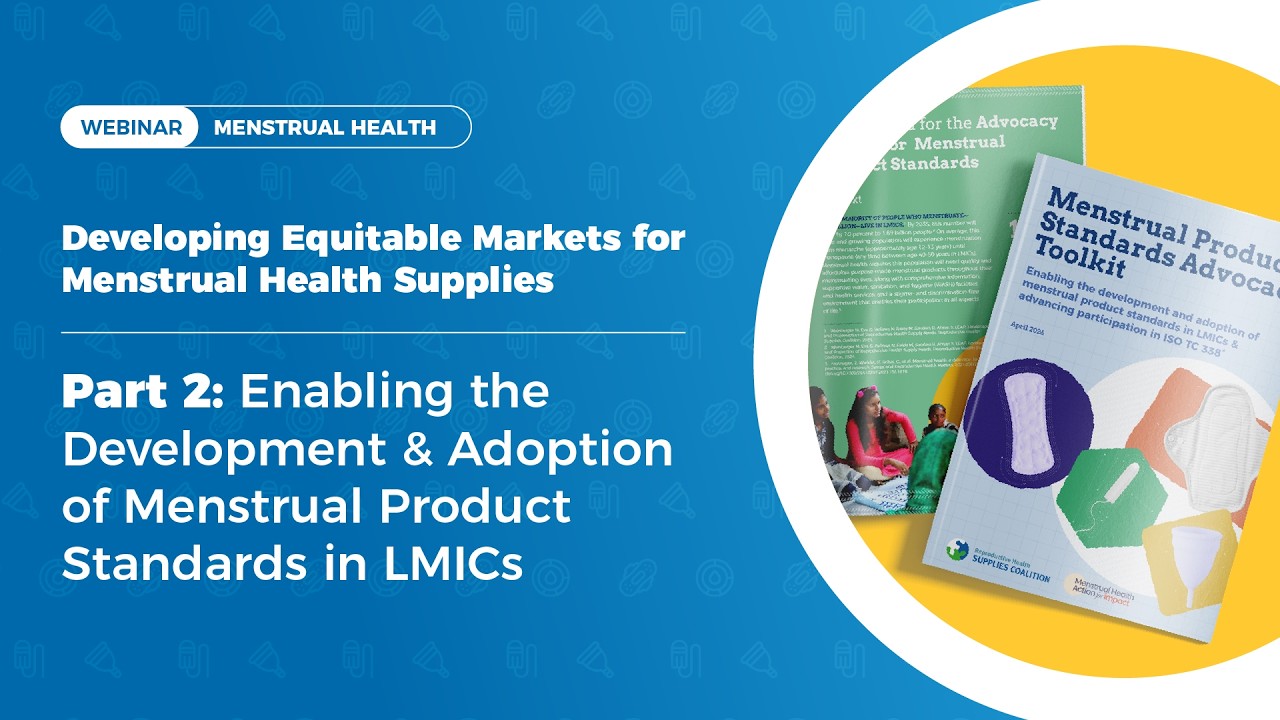
RHSC’s Menstrual Health Supplies Working Group has created a wide range of resources to support standards development, advocacy, and enforcement. In 2026, we published a Menstrual Product Standards Advocacy Toolkit, in partnership with Menstrual Health Action for Impact, which includes a suite of adaptable resources for a wide range of stakeholders to use in menstrual product standards advocacy. This toolkit builds on prior work of the working group. The group’s early efforts were foundational in the development of ISO TC 338 and ongoing conversations on product standards globally.

Menstrual Product Affordability and Tax Policy Reform
6 Resources
Menstrual Product Affordability and Tax Policy Reform
Currently, 613 million people who menstruate lack sufficient access to menstrual products. For many, affordability presents a significant barrier to access and drives inequity in who can buy menstrual products and who cannot. Significant strides have been made globally to reduce product prices, including efforts to leverage tax reform to ensure product affordability. Yet, they have often fallen short.
Taxes on menstrual products disproportionately affect women, girls, and people who menstruate in low- and middle-income countries. While significant progress has been made to remove the “period tax” in many contexts, this tax reform has not resulted in meaningful changes to product affordability and equitable access. This is because:
- There is often a lack of clarity behind how taxes, duties, regulatory fees, and markups through the supply chain shape price and affordability.
- Tax reform does not always result in cost savings to the end user.
- When savings are passed on to the end user, it is not always in an equitable way.
A better understanding of tax reform—and how costs are passed through the full value chain—is essential for improving product affordability. Improving product affordability across LMICs is possible, but it requires evidence-backed, coordinated advocacy. Tax reform requires a nuanced, country-specific approach.
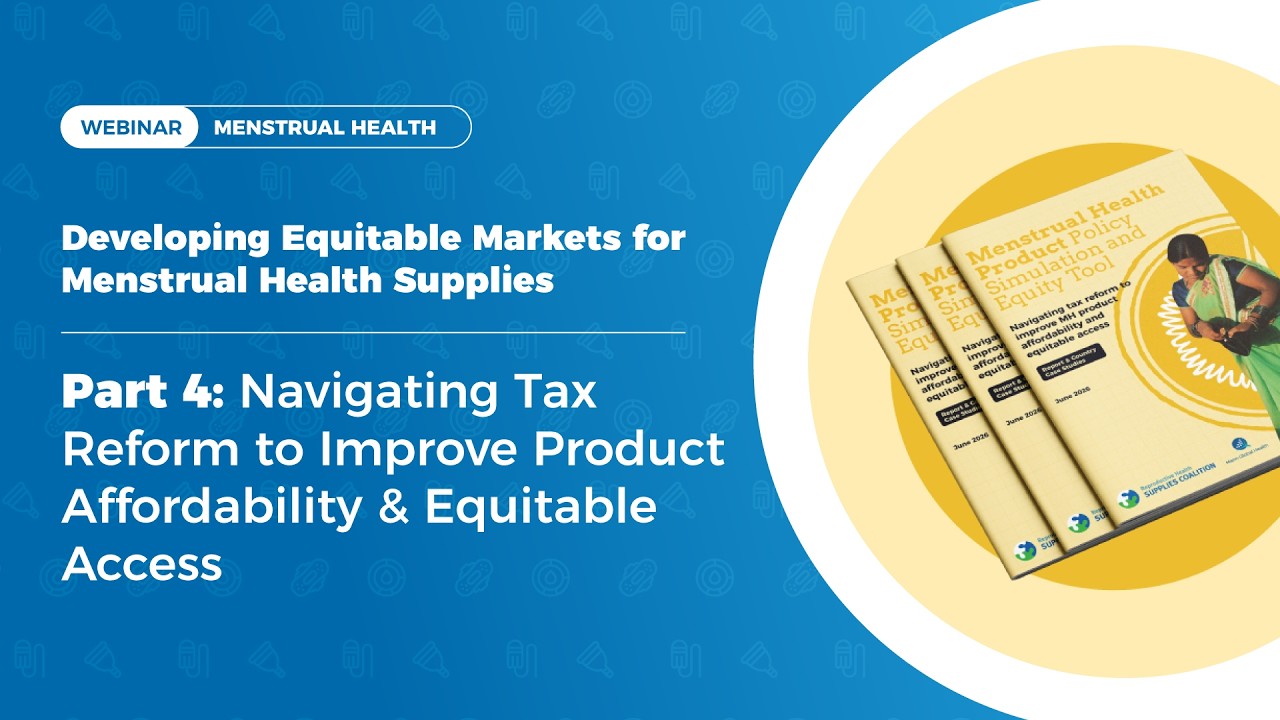
In order to better understand what drives product price and where there are opportunities to improve product affordability, we developed a suite of five integrated resources that move from evidence generation to methodology, modeling, country application, and advocacy—including a corresponding Menstrual Health Product Policy Simulation and Equity Tool. This work was done in partnership with Mann Global Health.
This new analysis builds on previous work that mapped global period taxes and provided critical advocacy resources for reducing taxes for menstrual health products. This work was done in partnership with WASH United.

Menstrual Health Supply Chains and Climate Change
6 Resources
Menstrual Health Supply Chains and Climate Change
Climate change and menstrual health supply chains are inextricably linked. Menstrual health supplies production and waste contribute to greenhouse gas emissions, while climate-related disasters threaten product supply chains and affordable, equitable access. All actors have a role in addressing the links between menstrual health and climate change, while ensuring that everyone who menstruates has access to the products they need.
There are an estimated 1.72 billion people who menstruate living in low- and middle-income countries. An estimated 93 percent of people who use purpose-made products are using single-use products. This contributes 250,000 tons of carbon dioxide annually—equivalent to 58,314 gas-powered vehicles. Simultaneously, climate-related disasters disrupt menstrual product supply chains, leaving end users without access to critical menstrual health supplies. There is a need to understand the links between menstrual product supply chains and climate change. And importantly, the responsibility for addressing these challenges should not fall on the people who menstruate, but, rather, through more coordinated collective action across the menstrual health product space.
To date, limited information is available on the impact of menstrual products on climate change—and the extent to which climate-related disasters disrupt product access. This creates a lack of clarity around “eco-friendly” solutions, assumptions about what “eco-friendly” products look like, and a lack of coordinated action in addressing these impacts.
Evidence-based, actionable advocacy recommendations are critically needed. Creating change is possible, but it will require greater collaboration and coordination. Critical pathways include:
- Stakeholder collaboration and participation across the product’s entire life cycle.
- Stronger global policies.
- Understanding the bidirectional relationship between menstrual health supplies and climate change.
Across all pathways, people who menstruate—and their needs—must be at the center.
In 2026, in partnership with the Climate Communications Collective, we developed practical resources, informed by experts, to promote tangible actionable recommendations to address the impacts of menstrual health supply chains and climate change. This work builds on prior work that the Menstrual Health Supplies Working Group did to investigate menstrual waste management.
Featured Webinars
We regularly host webinars to share emerging evidence, tools and resources, best practices,
and lived experiences from our members and partners.
-
June 17, 2026
Navigating Tax Reform to Improve Product Affordability & Equitable Access
Watch Webinar -
June 3, 2026
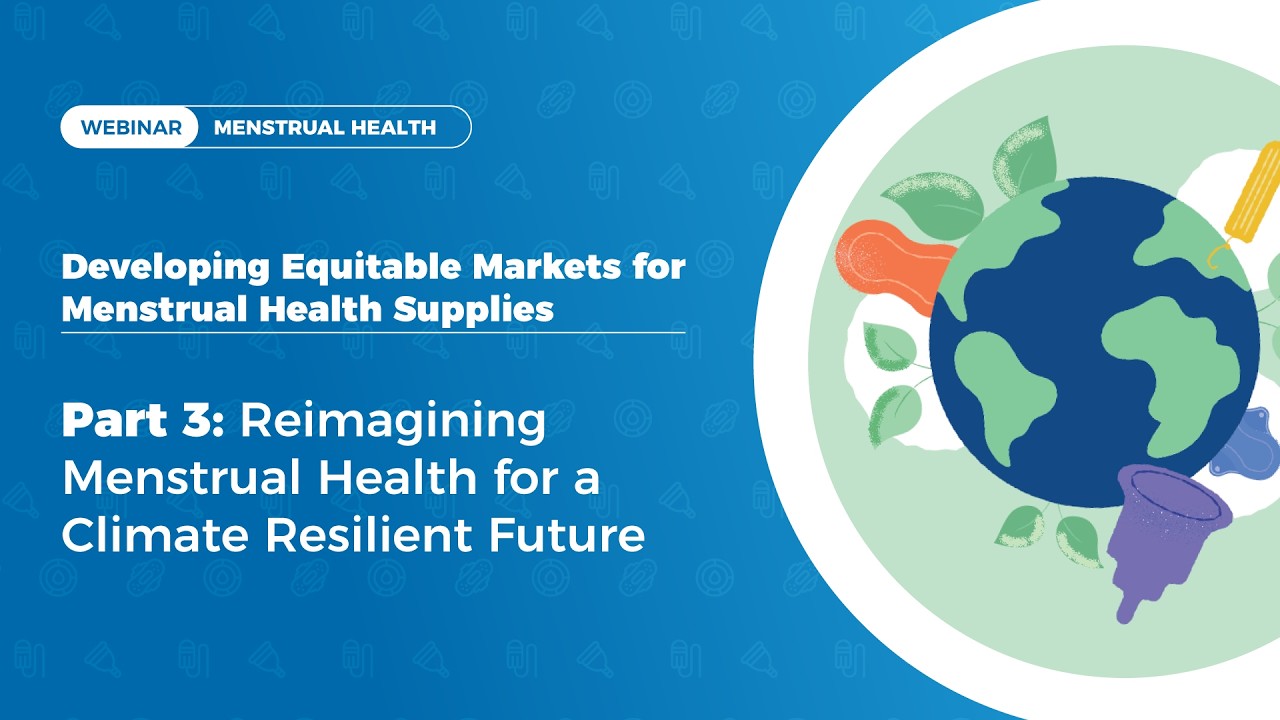
Reimagining Menstrual Health for a Climate Resilient Future
Watch Webinar -
May 20, 2026
Enabling the Development & Adoption of Menstrual Product Standards in LMICs
Watch Webinar -
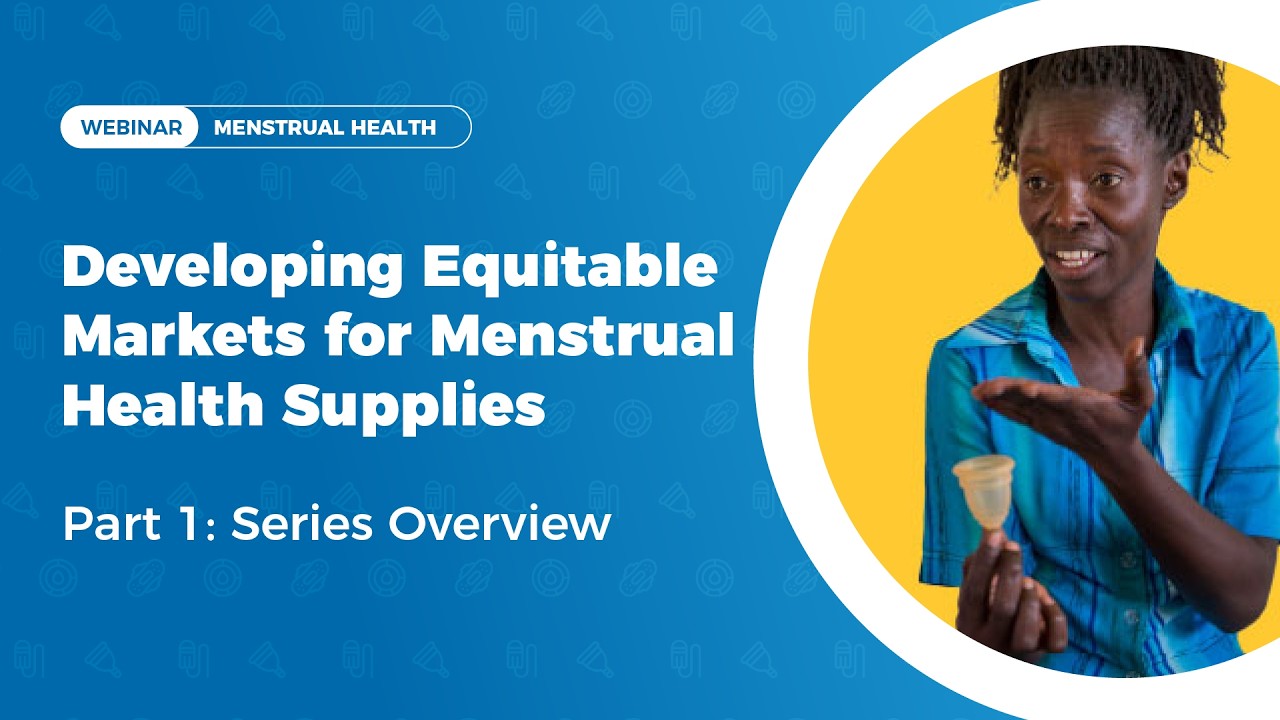
May 5, 2026
Developing Equitable Markets for Menstrual Health Supplies – Part 1: Series Overview
Watch Webinar -
October 15, 2025
Menstrual Product Standardization in LMICs: A Cross-Country Learning Exchange
Watch Webinar -
June 2, 2025
Joint Learning Series Part 3 – Africa Spotlight: Advocacy in Action
Watch Webinar -
May 9, 2025
Market Based Approaches to Menstrual Health
Watch Webinar -
March 4, 2025
Joint Learning Series Part 2 – Africa Spotlight: Leveraging Data for Market Development
Watch Webinar
Resources & Publications
Menstrual Health Supplies Working Group members collaborate to produce resources capturing best practices, advocacy messages, lessons learned, and emerging evidence to expand access. They also provide strategic input into Secretariat, member, and partner publications.
Latest Impact Stories
Read the latest stories to get a glimpse of the impact of the Menstrual Health Supplies Working Group.
Group Leadership & Contact
Working Group Chairs lead member collaboration, coordinate priorities and work plans, represent their
groups, and drive collective action to advance RHSC’s strategic objectives.
CHAIRS


Secretariat Contact

Ready to Join the Group?
This is one of the vehicles through which RHSC members collaborate.