
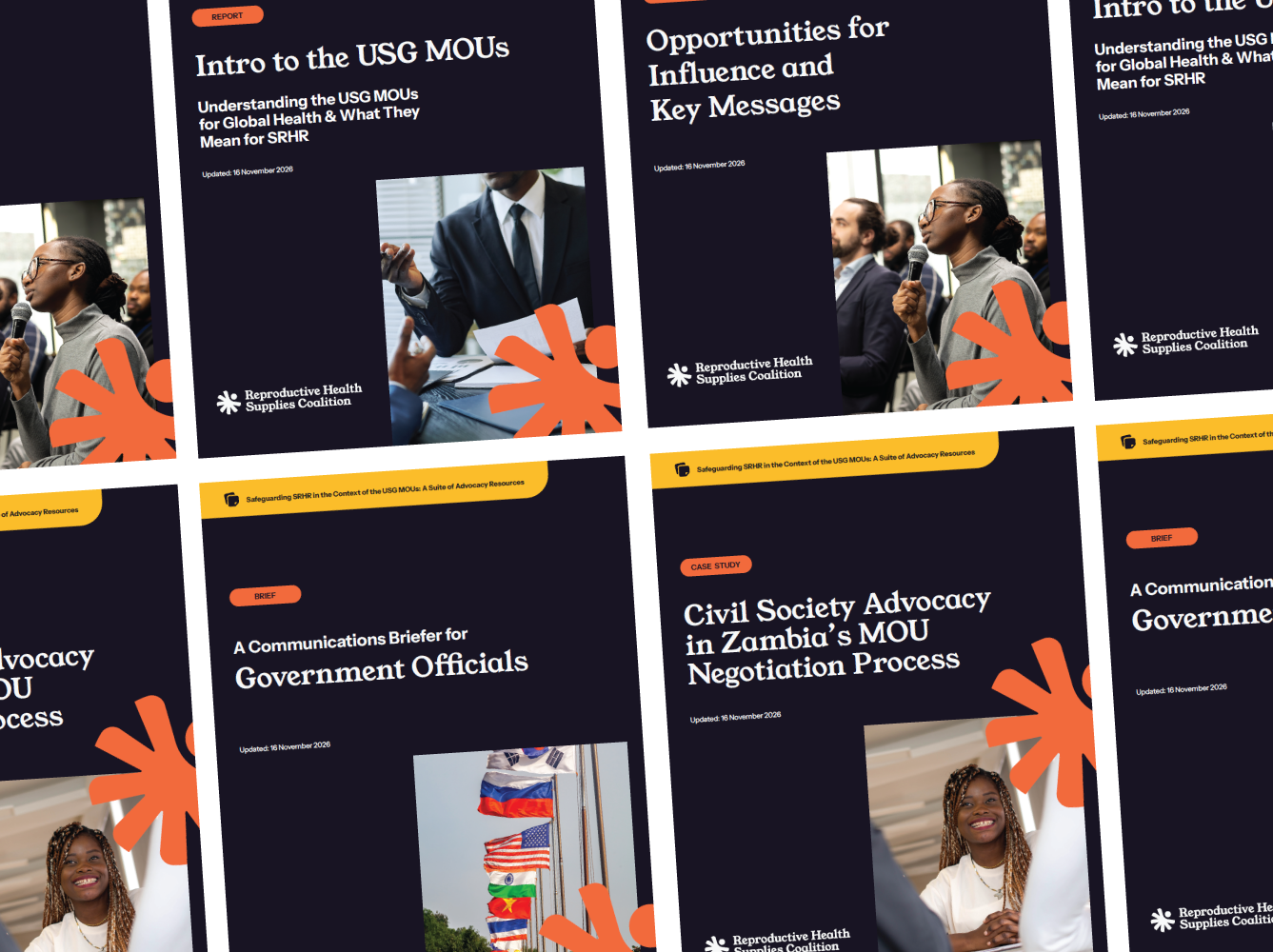


Through the Policy and Financing Advisory Group’s dedicated sub-group on the USG MOUs, we have launched a new suite of resources to support advocates and country decision-makers in safeguarding access to SRHR within the context of these MOUs.
In September 2025, the United States Government (USG) released a new strategy for its global health assistance: the America First Global Health Strategy. This strategy transforms the way that the USG engages in foreign assistance, shifting towards direct government to government agreements and away from its former approach of delivering global health assistance via USAID and a range of implementing partners. Before 2025, the USG was the largest bilateral donor for reproductive health globally, but under its new strategy no longer prioritizes funding for SRH. To date, the USG has signed 36 memoranda of understanding (MOUs) under this new strategy, beginning a new era of USG-supported foreign assistance. While the MOUs return funding from the USG to low-resource settings, the processes under which they have been negotiated have lacked transparency, and many SRH partners have voiced concerns about what they mean for access to SRHR supplies and services going forward. This is further complicated by a lack of clarity around whether the ‘Promoting Human Flourishing in Foreign Assistance’ (PHFFA) Rules will apply to foreign governments signing these MOUs.
Our set of MOU Resources—Safeguarding SRHR in the Context of the USG MOUs—is aimed at supporting advocates, civil society, and country decision-makers in navigating the MOUs and taking proactive action to ensure that SRHR remains a priority, outside of the context of the MOU Framework. These resources aim to (1) orient partners to relevant terminology and content of the MOUs, highlighting areas of concern for SRHR and improving visibility of the MOU process; (2) equip partners with an advocacy framework that outlines opportunities for advocacy throughout the MOU phases, including relevant advocacy messages; (3) provide tangible examples of how countries have navigated the MOUs; and (4) brief governments, civil society organizations, and media on the MOUs.
The set of resources includes:
- Intro to the USG MOUs, providing an overview of the MOUs, key terminology, concerns for SRHR access, frequently asked questions and additional resources;
- An Advocacy Framework with Opportunities for Influence and Key Messages, providing advocates with an interactive resource to identify critical moments for advocacy across the negotiation, implementation planning, and implementation phases and equipping them with adaptable messages to apply across different key moments;
- A Set of Communications Briefers for Government, Media, and Civil Society, providing a high-level overview of the MOUs and how government, media, and civil society can influence SRHR access;
- A Case Study on Zambia’s MOU Negotiation, highlighting the role that civil society played in the negotiation process and outcomes.
The full set of resources was co-created by RHSC’s Sub-Group on the USG MOUs throughout 2026. The resources will be updated as we learn more about the USG MOUs, PHFFA Rules, and implementation at country level.