

Since the late 1960s, when the Government of Kenya (GoK) first adapted family planning (FP) as a national policy, Kenya has made significant strides in FP access, with modern contraceptive prevalence rates (mCPR) for married women rising from 32% in 2003 to 57% in 2022 (KNBS, 2022) and targeting 64% by 2030 in FP2030 commitments. This progress is attributable to stronger political support, leading to national government allocations for FP commodities and county-level funding for service delivery.
However, despite the consistent pledges by GoK to invest in healthcare as one of the core pillars of Vision 2030 and the Bottom-up Economic Transformation Agenda (BETA), challenges in financing FP services persist. There is a need to prioritize FP within the broader health agenda, for increased domestic funding to ensure sustainable access to quality FP information, supplies, and services.
Kenya’s health system is highly dependent on donor funding, with a few international non-governmental organizations providing significant contraceptive services in remote areas. Over the last few years, the U.S. Agency for International Development (USAID) contributed about 20% of the FP commodities. Hence, the funding suspension and reintroduction of the Global Gag Rule (GGR) has had a significant impact on FP programs in both public and faith-based facilities, which relied on USAID-funded projects. This, and reductions in funding from other bilateral donors, has exacerbated an already strained funding landscape.
Agreeing on a path to reduced donor dependence
Following Kenya’s transition to a lower middle-income country in 2014, donor attention shifted to other countries, leading to drastic cutbacks in funding, adversely affecting the allocation of resources towards FP commodities, leading to frequent stockouts and reduced FP access, particularly among marginalized communities.
With a looming crisis of contraceptive stockouts due to donor cutbacks and commodity budgeting challenges faced by counties, a coalition of key FP partners reached out to the national government to identify a workable solution. A matched fund and sliding scale initiative was laid out in a Memorandum of Understanding (MoU) between the GoK and donors. The MoU set out the obligations of both parties, and created momentum for more resilient, long-term funding, with relative government investment progressively increasing on a sliding basis, from 1:1 government to donor in 2021, to 4:1 by 2024.
The MoU was initiated with the GoK committing a series of budgetary amounts for each fiscal year (FY) starting with commitment of US$10.9 million in FY 2019/20 increasing annually with a slight drop to US$7.1 million in FY 2023/24. However, despite these commitments, actual expenditure on FP commodities fell short of allocations. Between 2020/21 and 2024/25, US$149.5 million was allocated, however, only US$36.8 million, 40% of the allocation, was expended. Notably, in FYs 2022/23 and 2023/24, none of the allocated funds were spent. Despite the good intentions, GoK is yet to meet its obligations. It was becoming clear that budget advocacy needed to be more nuanced so that it addressed not just the barriers to getting funds committed but also the challenges relating to expenditure.
How Political Economy Analysis Informed SMART Advocacy for Domestic Financing
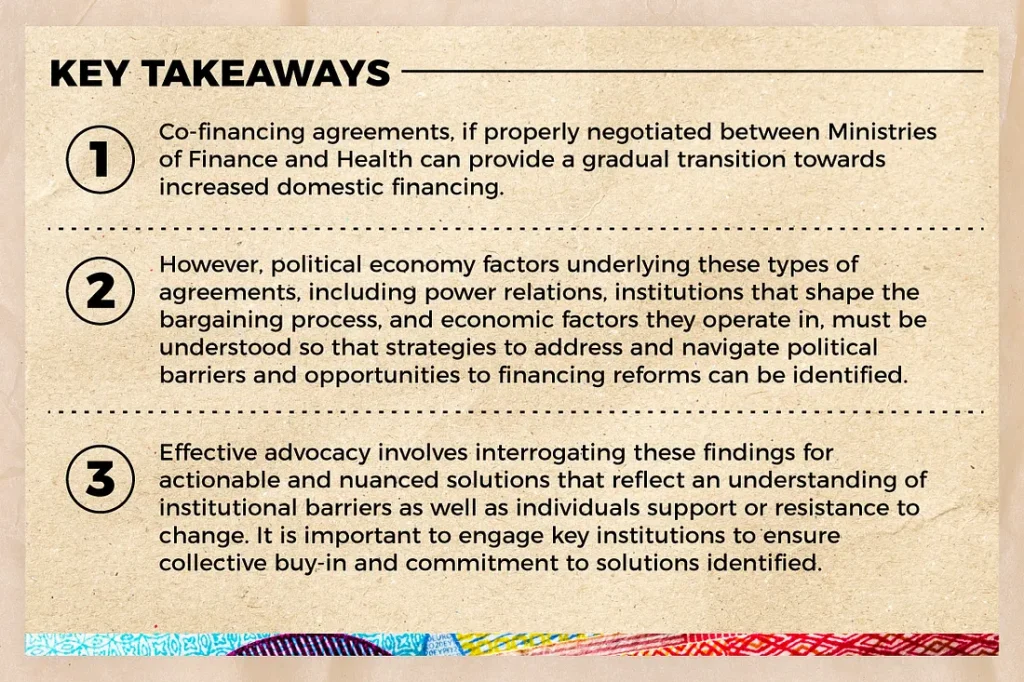
The Ministry of Health in Kenya, like in many countries, seeks to promote equitable and affordable access to quality reproductive health (RH) services by reforming health financing policies. However, agreement on the importance of domestic financing of FP commodities has not translated into increased budget allocations. Health financing decisions around expanding coverage involve complex interactions among a range of stakeholders in the health sector and beyond, of varying power and influence. Added to this are changes in the macroeconomic context, such as debt repayment or economic downturn that directly impact feasible reform options. This makes reform politically contentious and difficult to adopt or implement.
Political Economy Analysis (PEA) is the systematic exploration of power relationships between different stakeholders, the institutions that shape the bargaining process and the contextual and economic factors that they operate in.
Therefore, the objective PEA in advocacy efforts is to increase the likelihood of effective design, adoption, implementation and ultimately sustainable financing of FP commodities.
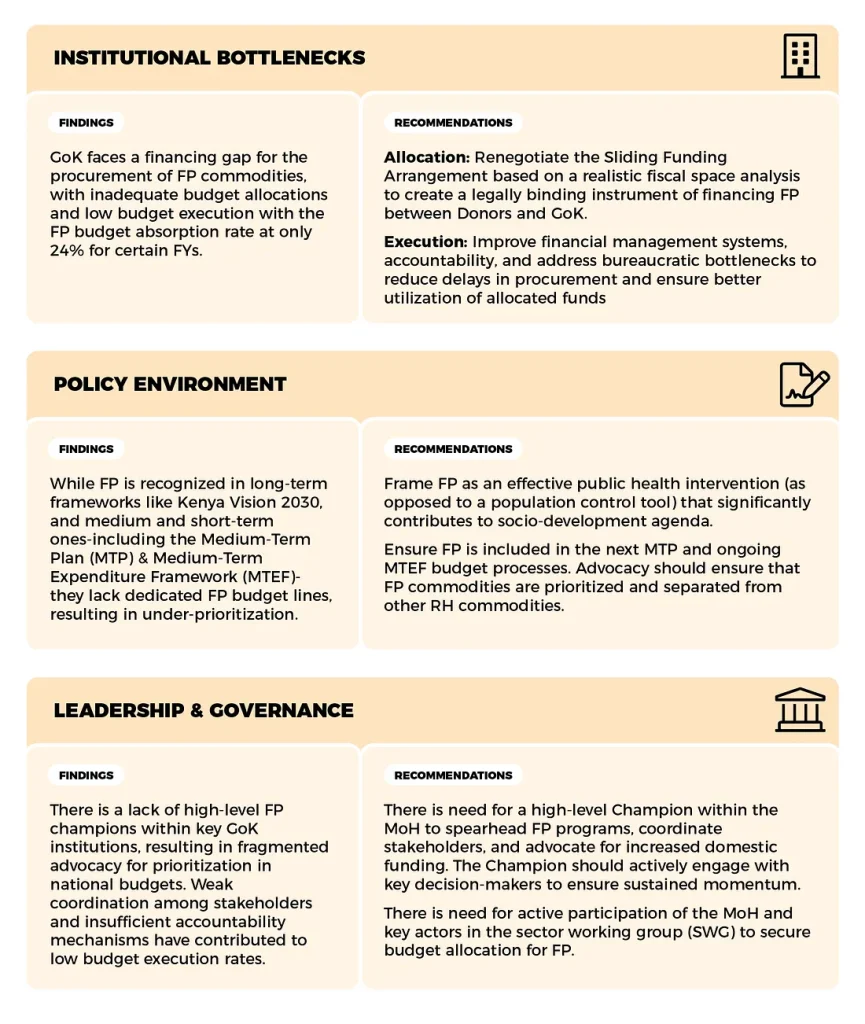
In 2024, Options, in collaboration with UNFPA, through the FCDO-funded DESIP program, conducted a PEA to identify factors contributing to the under-allocation/utilization of FP commodity budgets. Specifically, the analysis explored the funding landscape before and after the signing of the MoU and challenges encountered in financing GoK commitments. The PEA delved into reasons for under-utilization of allocated funds. The analysis provided an incisive synthesis of the key factors contributing to the challenges, opportunities and recommendations for addressing the challenges. These are expected to guide and support FP SMART Advocacy efforts for increased budgetary allocations and expenditure.
While these efforts have not yet resulted in resource mobilization from the GoK, there are several important lessons learned, recommendations for action, and opportunities to apply these insights to other country contexts . The table below presents some of the key findings and recommendations of the PEA, many of which could be applied to additional geographic settings:
The effective implementation of the recommendations from the political economy analysis requires collective commitment from ministries of health, finance as well as parliamentary committees. Through ongoing collaboration and engagement, sustainable financing for FP commodities and services is achievable.
To learn more about the PEA approach in Kenya, and impact on domestic resource mobilization, check out the full report by Options: https://options.co.uk/publication/a-political-economy-analysis-pea-on-domestic-financing-for-family-planning-commodities-in-kenya/