


When the Zika epidemic took Latin America by storm in 2015, it hit the most marginalized populations the hardest — the women with the least access to contraception. Yet, ironically, many governments were telling women not to get pregnant, in order to avoid delivering babies with microcephaly and other serious health problems. The NGO community grappled with debunking the myths and superstition surrounding both Zika and contraception.
In response, the Coalition’s ForoLAC, the regional forum for Latin America and the Caribbean, provided a platform for discussion — a webinar to which 500 individuals signed up in just days. The major outcome of this was that several participating donor agencies and manufacturers left with a clearer sense of the outstanding need. USAID became one of the first agencies that diverted funding not used for the Ebola epidemic to fight Zika, and projects with URC (the University Research Company) and Jhpiego dedicated their efforts to work in LAC in fighting the epidemic and in improving the diagnostics of the disease.
In this instance, the Coalition had called on its particular levers of change — its convening power, brain trust and flexibility (afforded by a broad resource base and the ability to respond quickly to time-sensitive RH issues) — to address the Zika issue soon after it came up.
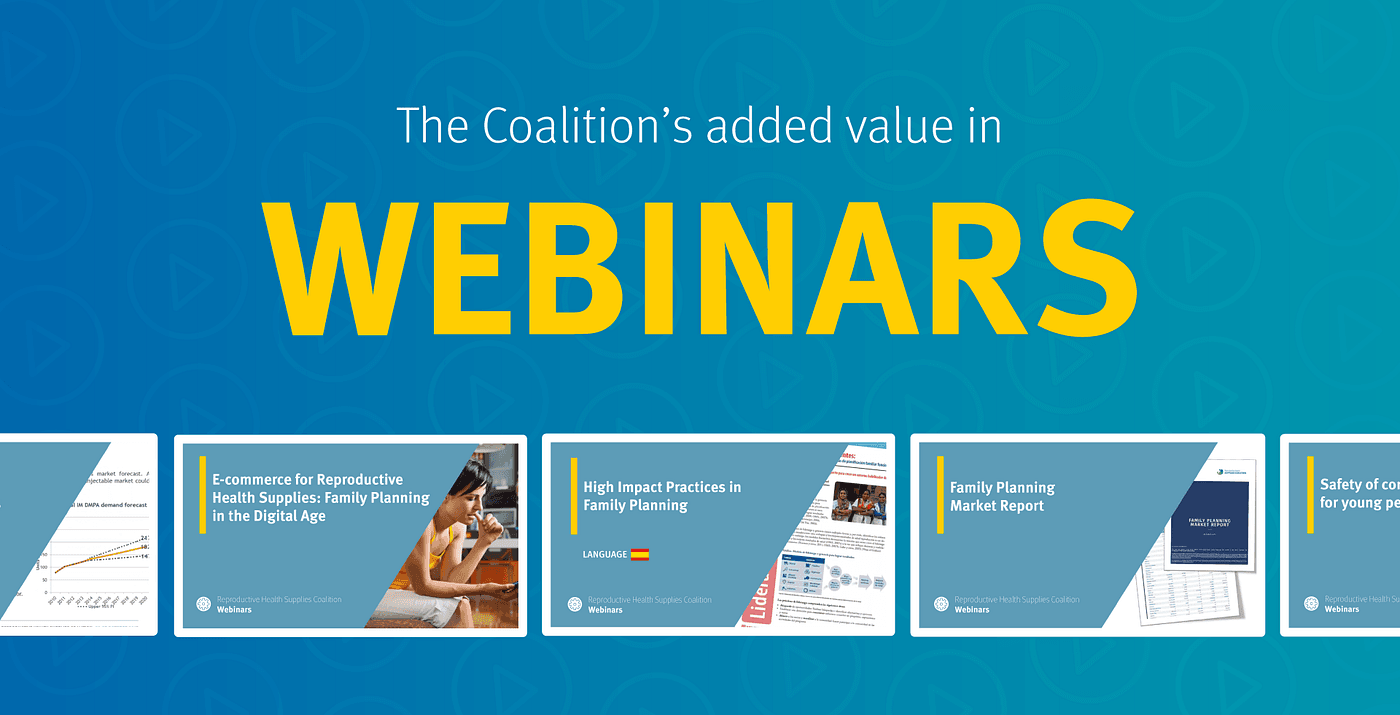
Webinars are an intrinsic part of the added value the Coalition offers to its community. In the last 10 months alone, the Coalition has hosted or co-hosted 30 webinars, for which nearly 2,000 individuals registered, nearly 1,000 attended, and more than 1,000 accessed after the event on the Coalition’s YouTube webinar hub.
The word “webinar” is, of course, a conflation of “web” and “seminar”, a live web-based video conference that uses the internet to connect the presenter to an audience from all over the world. The benefits of webinars are substantial, perhaps the first that comes to mind being cost savings. The Coalition’s provision of these virtual learning opportunities might have, in effect, circumvented transport, accommodation, board and per diem expenditure that might have been incurred by up to 2000 + individuals travelling locally, nationally or internationally.
Webinars also sidestep time considerations; they can be recorded and accessed after the event, overcoming time zone discrepancies and extending event time. Key speakers may find it easier to commit to one or two hours presentation time on a webinar rather than having to travel in person to a live meeting. Webinars are also ultimately flexible; if absolutely necessary, individual presentations can be pre-recorded and slotted into live webinar agendas.
Flexibility is a byword where webinars are concerned. When the Dakar General Membership Meeting 2017 was postponed by five months and rescheduled for Brussels in March 2018, different Working Groups — MDA, MHS, NURTH and the Safe Abortion workstream — organized webinars to host cancelled plenary presentations, leading up to the Brussels meeting. They were able to sustain the meeting buzz over months, and to build anticipation for the postponed event effectively.
Furthermore, as Secretariat staff have discovered, co-organizing a webinar with a partner agency has its particular benefits; for one, announcements reach a large, pooled audience and the event enjoys wider publicity.
It is worthwhile noting that a return flight between Nairobi and Washington, D.C., is said to create the emission of 1.78 metric tons of CO2e or greenhouse gases. While it’s difficult to attach a meaningful value to how much environmental damage virtual meetings like webinars actually offset, it is fair to say that they definitely present an ecologically sound alternative to international air travel.
Webinars, of course, have their own drawbacks. The format lends itself to more formal information-provision and a controlled Q&A component. It does not work as well for advocating immediate action as it does not lend itself to spontaneous emotional interaction, or for that matter, brainstorming. Also, because people can be uncomfortable about speaking into a screen and addressing an unseen audience, one downside of webinar dynamics is occasional periods of silence when responses to presentations are called for.
Still, groups who have attended webinars over a period of time do warm up to one another, maintain experienced organizers, and within the Coalition community, many webinars tend to build up to an in-person meeting.
In a time when we are overloaded with printed information, having the opportunity to hear people tell their own stories, take us through our imagination to where they are actually implementing their projects, and bring us closer to their research labs is priceless. The Coalition’s founding principle was to provide a table around which all members could gather, and where country-level partners could take part in the global discussion. Webinars have become an integral component of that strategic vision.