
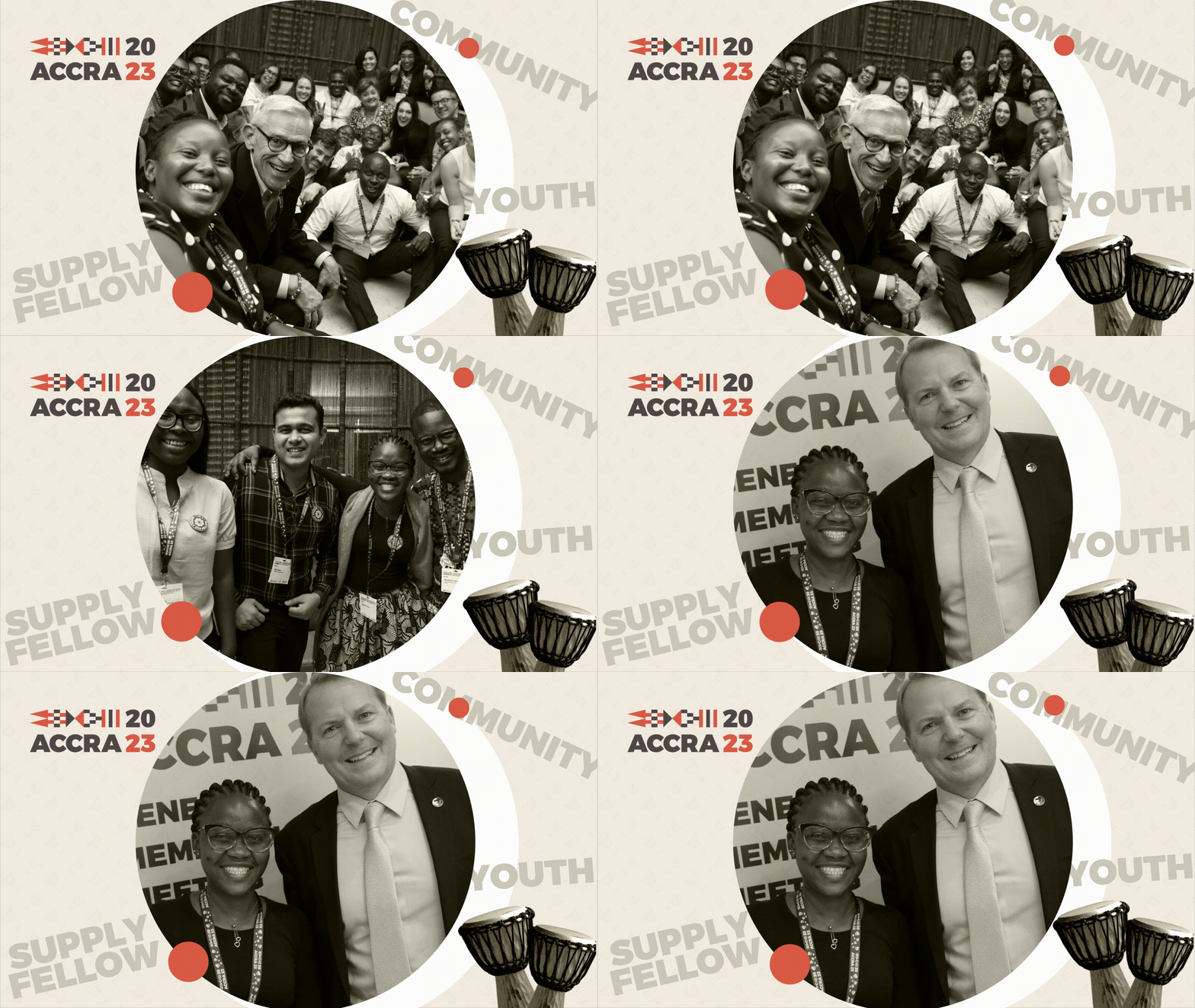


These words continue to echo in my mind weeks after the 20th General Membership Meeting of the Reproductive Health Supplies Coalition has ended. It has become my constant reminder that at the facility level, a long chain of processes is involved any time an adolescent girl gets access to a family planning commodity as needed. After participating in this year’s membership meeting, I cannot help but reminisce about my experience during the meeting in Accra. From the team at RHSC to every individual I encountered, my experience was a great one, and while the meeting is over; these experiences live on. Empowering me and motivating me to continue to tell the stories of the people behind the systems of supply chain. Here is a sneak peek of my experience:
Walking the talk of Intergenerational Collaboration
A key role I played during the RHSC meeting was reporting and providing on-the-ground update through the Family Planning News Network. My task list was super busy: interviews, sessions, articles, and networking, among others. This was my first time attending an RHSC membership meeting. Who would make it to my interview list? Do they know me? These questions ran through my mind as the first day approached. All these questions vanished as I met the Communications Manager at the Reproductive Health Supplies Coalition, Hannah Pandian. With her broad smile and assurance of providing any support needed, my week during the meeting was amazing. Together with the other team members, I experienced a great intergenerational collaboration and working environment. With just an email or WhatsApp introduction, Hannah facilitated my interviews with the likes of Martyn Smith, Director of RHSC, Pamela Steele of Pam Steele Associates, Simplice Kamdem, Sr. Health Systems Strengthening & Policy Advisor at USAID, and amazing young people who participated in the meeting. Lucian Alexe, Senior Communications Officer at the RHSC and videographer during the interviews, ensured my smooth reportage from Accra all the way to Maryland, USA.
Becoming a SUPPLY FELLOW
Today, I am an RHSC Supply Fellow, part of RHSC’s ongoing initiative to match veteran supply chain experts with younger colleagues at an earlier stage in their careers. Benefiting from the wealth of experience, expertise and knowledge of older experts working within the supply chain of reproductive health supplies. The Supply Fellows initiative gave me a new sense of hope and faith of how intentional mentorship and capacity building could be a great way to ensure a sustained chain of professionals who share same visions within the space and building a stronger next generation of supply chain experts. I met and heard the stories of other young Fellows from Zambia, Nigeria, Togo, Cameroon and Tanzania. As young people sharing a similar vision, we bonded from our first encounters, building an allyship and network that still continues although the meeting has ended. Throughout the meeting, this network of young people spoke with one voice, pushed with a common agenda and ensured that our voices were echoed stronger as we engaged meaningfully and took our seat at the table.
Becoming a Supply Fellow, has within the shortest time, not only challenged me to identify, analyse and acknowledge intersections and integrations of my work as an advocate at the community level but most importantly understanding and appreciating how these experiences better position me to be more engaging with stakeholders and sectors within the reproductive health space. As a Fellow and advocate, my advocacy now not only spans what people get at the facility but also quality, effectiveness and financing to ensure stock outs are things of the past. My advocacy is now broadened to use media as a tool to tell the stories on supply chain and the people behind them. Because indeed behind the process of commodity production through till it reaches the clinic, there are people, people who believe in reproductive health rights, people who believe in women’s rights and access to products and people who share in the same passion as my advocacy.
A Community
Have you ever entered a place all lost but immediately feeling found and belonging? Before the meeting I was anxious and not so sure what I was to expect during the week. All this vanished when I was greeted by another participant of the meeting. During the week, it was hard to identify who was new in the room or who was not, because the warmth of each member made conversations easier and networking very engaging.
An aha moment for me during the RHSC meeting was the drumming session. It was amazing to see how the symbolism of the drum was linked to the RESILIENCE that was being celebrated by the coalition. But for me this symbol was deeper. Wondering why? As the drumming session was happening, I reflected on what drums and drumming meant in my context. In Ghana, drums hold a deeper, symbolic and historical significance. Drums are used to announce the presence or arrival of kings and dignitaries. Drums are beaten to announce major events and wars. Drums speak. Their significance as a means of communication in societies to deliver key communiques from kings and chiefs cannot be over emphasized. Additionally, drums signify celebration, drumming accompanied by dancing is always evident when good tidings are received. As I reflected on these, my thoughts wondered on what this meant for the coalition as a community and as family. Beyond the symbolism of how the tightening of the Djembe drum and pulling it made it resilient, I celebrated the members of the coalition, I heralded their entrance into a new era and a stronger future of reproductive health supplies. To me, it was to announce the presence of a stronger Coalition moving forward and rallying all together to leave no one behind and reaching the last mile. The drum was to announce my own grand entry as a Supply Fellow and to celebrate the collective efforts of those that blazed the trail before us.
The general meeting is over; all who travelled are back home now; but for me, it’s these experiences that have shaped my thoughts and actions moving forward. It keeps sounding like the Djembe drum reminding me of the beautiful melody we make when women and girls, young people — and everyone — have access to affordable, quality RH commodities. That it is people who manage supply chains. I promise to tell their stories, share their stories wherever they are.
My advocacy continues, my reportage continues,Thank you, Reproductive Health Supplies Coalition,Esenam Amuzu — Ghana
Esenam Amuzu is youth advocate in sexual and reproductive health rights and youth development. She is also a reported with the Family Planning News Network; her presence at the RHSC’s General Membership Meeting was sponsored by the Bill & Melinda Gates Institute for Population and Reproductive Health. Her coverage of the RHSC meeting can be viewed here.