


Good partnerships are the foundation for strong supply chain systems. I’d like us to think about supply chains beyond the trucks and warehouses and spreadsheets that might immediately come to mind.
To me, supply chains are the heartbeat of family planning and reproductive health programs. When they work well, they are steady and rhythmic, they deliver products, gather information, and they save lives. At the same time, supply chains are also the threads of a fabric (or a program), weaving together people, products, processes, data, technology, funding and promises — connecting a woman in a community pharmacy to a distributor in a capital city, a regional manufacturer, a Ministry policy maker and a government treasury decision maker.
When a heartbeat falters…
But when a heartbeat falters, the whole body feels the impact. And when a single thread snaps, the whole fabric becomes weaker. When COVID-19 struck, our collective heartbeat skipped — and, for a time, even stopped. Cargo routes froze. Borders closed. In Kenya and across East Africa, supply chains that had taken decades to build began to unravel. Our teen pregnancy rates shot through the roof, and we lost valuable progress in many health indicators.
We saw where the threads were weakest — we were (1) too centralized, (2) too donor-dependent, (3) too far from where women needed care.

“What if pharmacies could become a legitimate, trusted part of the national family planning and self-care fabric?”
Yasmin Chandani
But one place where that pulse stayed the strongest….
But one place where that pulse stayed the strongest was in community pharmacies — especially neighborhood chemists. Community pharmacies became the threads that quietly held the fabric together when everything else was fraying.
A community pharmacy is where most Kenyans go when we have health issues. My neighborhood pharmacy is on speed dial when my kids are sick — the pharmacists know me, greet me and I’m in and out in a couple of minutes. During Covid, pharmacies were embedded in the fabric of communities, adapting rapidly, adding home-delivery methods and adopting telehealth methods.
Post Covid, the Kenyan Health Ministry wondered — “What if pharmacies could become a legitimate, trusted part of the national family planning and self-care fabric?” Through support from the Gates Foundation, and partnership with government partners and stakeholders, we started to weave pharmacies into the family planning total market approach.
It is not easy to shift the mindset that the public sector is not the only place you can get quality family planning. We had to align regulations and policies, train pharmacy providers in counselling and choice, in how to inject, and help them build trust and client confidence. We had to connect digital and reporting systems and build value chains so pharmacies could offer choice and consistent supplies.
We learned two important lessons: firstly, we needed multiple partners to buy into this shared vision. And secondly, to innovate within governments, we needed to build trust and work together across multiple arms of the ministry and not with just one program or contact.
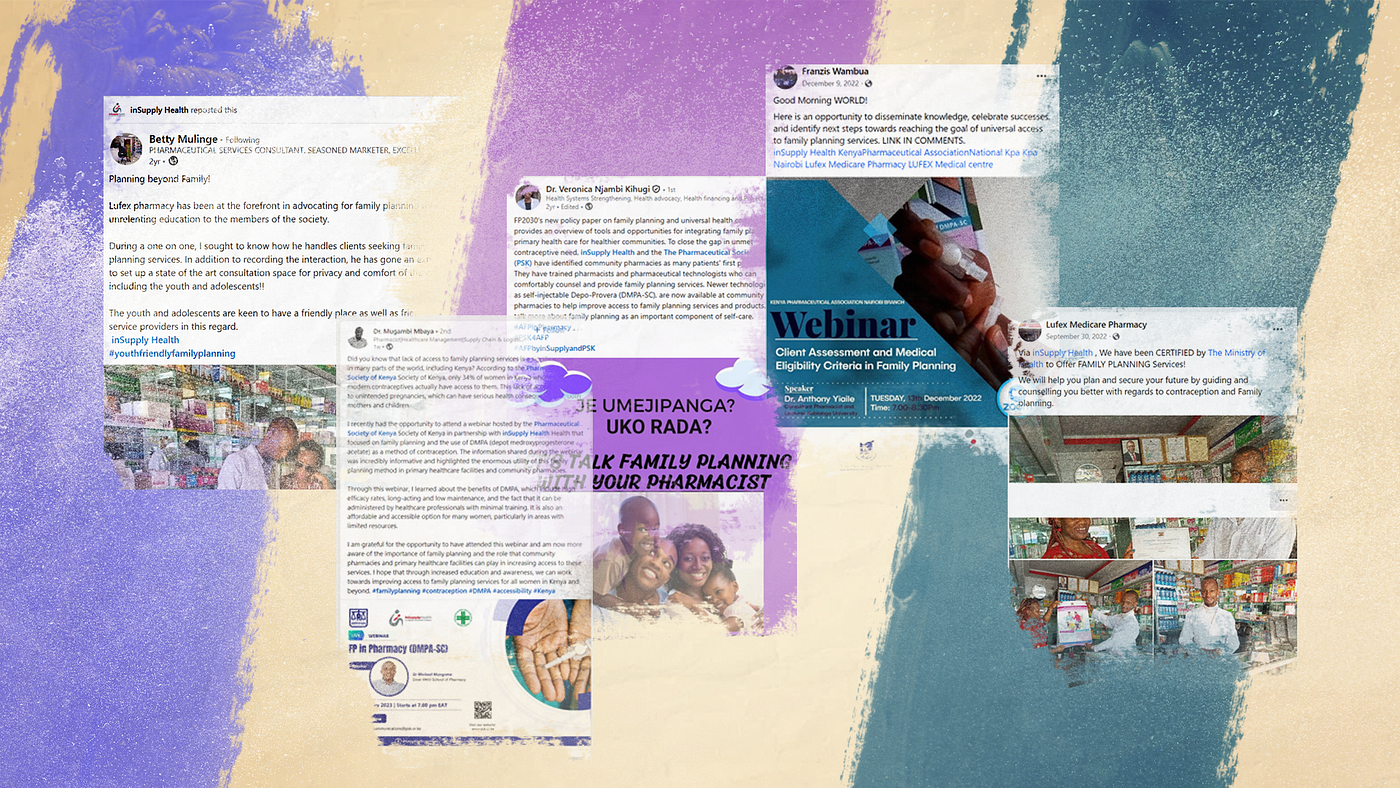
To support commercializing the supply of self-injectables, we worked with the ministry and professional associations to train almost 500 pharmacies and digitize the curriculum to enable rapid scale up of this pharmacy model. Pharmacists learned to start talking to women about contraception when they came in for other items. They offered women a safe, private space for contraceptive counselling. We checked in with them every month to help problem-solve and supported some of them to adopt social media marketing, which proved to be effective. Women told their friends and as demand grew, pharmacies took ownership of their supply chains. Within months, more women were coming in for contraceptive injectables in our partner pharmacies, and most importantly, pharmacy owners and operators started to understand how important offering quality family planning services could be for business.
Fast forward to 2025, with global funding cuts causing a significant gap in family planning financing. Our heartbeat took a shocking blow.
Fortunately, in Kenya we have a little hope. We can now explore multiple initiatives: scaling up family planning through pharmacies; exploring how our new social health insurance fund can reduce out-of-pocket payments; and investing in domestic financing for contraceptives. Thinking outside the box after the pandemic has shown us that as a country, we can be resilient, responsive, and resourceful.
“I can see a future where pharmacies, clinics, and ministries are all part of the same fabric”
Yasmin Chandani
At inSupply Health, we are doing our part to explore how to help ministries maximize their resources. In the last two years, we have co-created AI-enabled forecasting tools in Kenya and Tanzania with our ministry partners — with excellent results. Data extraction and cleaning takes 15 minutes compared to 2-and-a-half days previously. We can use more data, more robust methods and we have high accuracy rates for stable methods that have good data. But again, this transition was gradual and called on building trust. Users had to compare the processes side-by-side, validate cleaned data, and accept the innovation slowly. But it has been a success, and we are handing the tools to the ministries.
I can see a future where pharmacies, clinics, and ministries are all part of the same fabric and where governments don’t just manage donor pipelines but finance, monitor, and optimize their own resilient supply chains. And where women are at the center and can afford their family planning method of choice AND access it conveniently, without bureaucracy or bias standing in the way.
We are at an inflection point
We are at an inflection point in our industry — like never before. It’s time to: (1) act decisively and boldly, (2) invest in tools for efficiency so we can do more with less, (3) galvanize a domestic financing agenda to reduce dependency, and (4) accelerate strategies that help our systems continue to serve women and their families. It’s time to invest in our collective heartbeat, to strengthen our supply chain fabric.