



Earlier this month, news broke that the U.S. Government planned to destroy over $9M worth of family planning commodities that had been purchased to support family planning access in low-and middle-income countries.¹ ² These commodities were already paid for by American taxpayers and will cost additional taxpayer dollars to destroy.³ ⁴ This destruction follows the U.S. Government’s decision to halt its funding for family planning entirely.
Understanding the impact that this will have requires a bit of context of global family planning supply chains and how they enable access to life-saving products for women and girls. Yes, women and girls will lose access to family planning commodities — but that’s not the whole story, nor does it do justice to the magnitude of impact. What does $9.7M worth of family planning commodities mean in the context of global access? That is the story that we want to tell you today — the story of why this $9.7M in contraceptive commodities matters and why we cannot let it be destroyed. And we are well-positioned to tell it. The Reproductive Health Supplies Coalition is a global network of over 500 organizations dedicated to ensuring that women and girls have access to a wide range of quality, affordable reproductive health supplies.⁵ We create a neutral convening space for partners to come together, access data, and collectively respond to urgent issues that threaten access to these supplies. We are purpose built to meet this moment — it is quite literally our mandate.
What is at stake
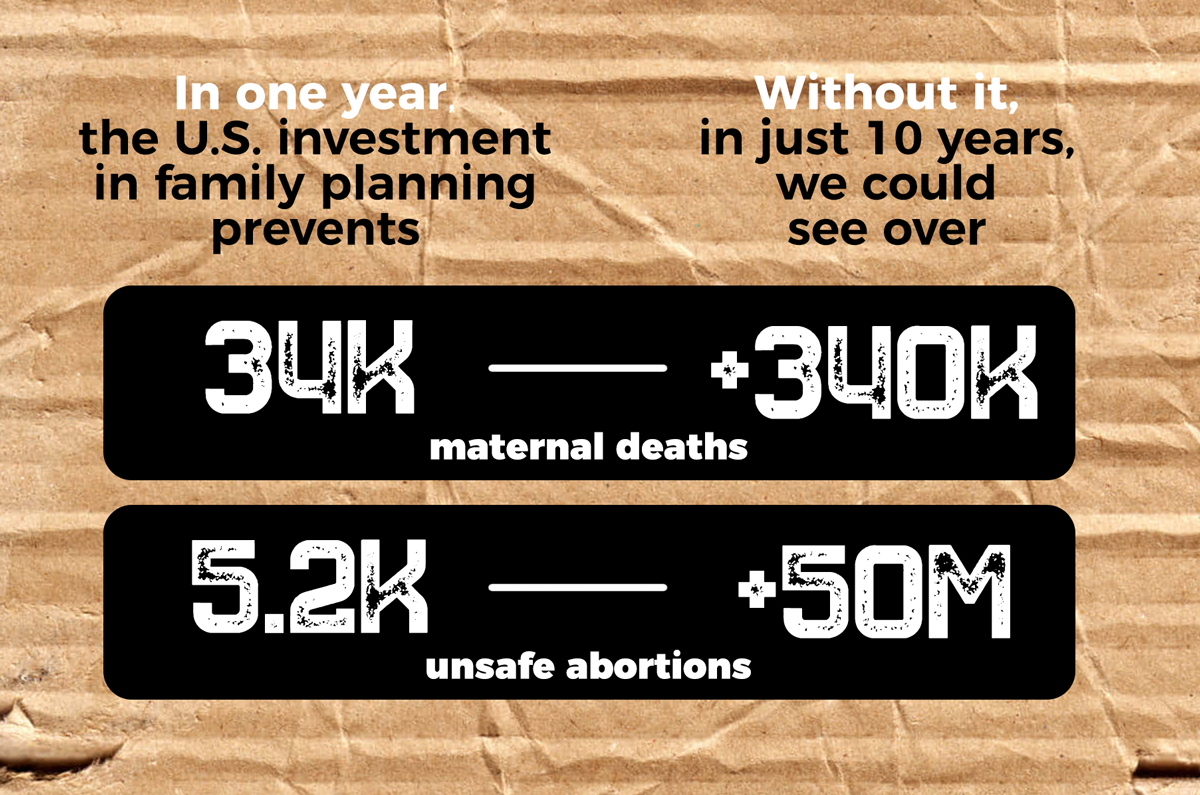
When digging into the details of commodity supply chains, it’s easy to lose sight of what’s at stake — so our story will begin there. Millions of human lives are at stake. In just one year, the U.S. investment in family planning serves nearly 48M women and couples, averting 34K preventable maternal deaths. This investment prevents over 17M unintended pregnancies, 7.6M unplanned births, and 5.2M unsafe abortions. Without it, in just 10 years, we could see over 50M unsafe abortions and 340,000 preventable maternal deaths.⁶ Family planning commodities are life-saving commodities — and in addition to saving lives, they enable reproductive choice and autonomy, economic development, and gender equality.
Historically, the U.S. has consistently been the largest bilateral donor to family planning globally, contributing $600M (approx. 7% of its total global health contribution) annually for the last 10 years. The U.S. accounted for 40% of total donor government funding, and supported every level of the supply chain, and important inter-locking systems that ensured that products could get to the women who need them.⁷ This included supporting forecasting and supply planning, by funding information systems and tools, technical assistance, and capacity building. It included funding the procurement of family planning commodities, as well as the transportation, storage, and logistics management systems. It included supporting service delivery through provider training, demand generation, and policy development.
At this point in our story, we will zoom into the procurement of these commodities. The U.S. has historically accounted for 25% — or $61M annually — of global-procurer investment. For 2025, there was an estimated funding gap for family planning procurement of $167M across 32 countries. This gap represents the disparity between funding committed to family planning procurement and what is actually needed to meet the demand of women and girls and maintain desired stock levels. The cancellation of the pending USAID procurement commitments increases that gap by 26%, totaling $210M for 2025.⁸ There is no single donor who can make that up overnight. Especially when it layers on top of an already existing funding gap.
Those cancelled orders have real, tangible impacts on country-level access to family planning commodities. Looking at supply plans from 10 countries shows us that almost every family planning method is at risk of stock-out in at least one country this year. Six countries are facing stock-out risks for 2+ products, and 6 countries have 2+ products falling below minimum stock levels before the end of 2025. The effects are more profound for some products than others. Injectable contraceptives and contraceptive implants face the largest funding gaps at approximately $18M each. For male and female condoms, combined oral contraceptive pills, and injectable contraceptives, USAID accounted for one third or more of the global procurer spend.⁹
Why the $9.7M at Risk of Destruction Matters
Beyond the stockouts we are seeing at the country level, the supply chain as a whole is fractured, and other investments in family planning programming — which relied on that supply chain — are now also at risk. In addition to stockouts, countries are facing extended lead times and increased costs. Suppliers are facing challenges with production planning and the heightened cost of operating in fragmented, uncertain markets. Data collection and needed visibility into supply challenges are limited as donor-funded systems slip. And providers face a loss of competency.
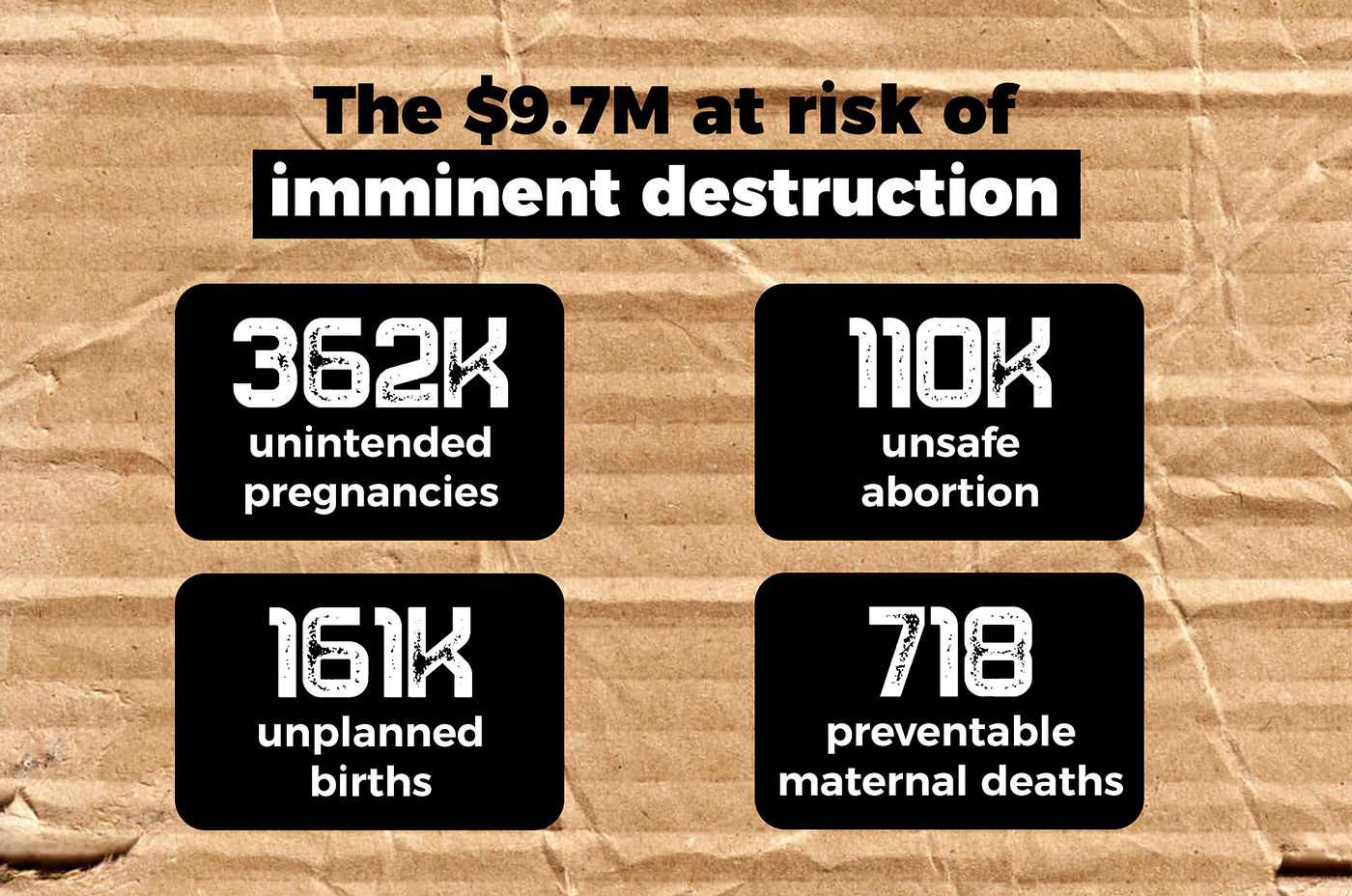
At this point in our story, you may be wondering why these commodities — the $9.7M at risk of imminent destruction — matter. Not only would destruction cost additional American taxpayer dollars (at least $167K, though we estimate the true cost is much higher), it would cost human lives. For every $10M reduction in family planning, the impact is 362K unintended pregnancies. 161K unplanned births. 110K unsafe abortions.¹⁰ And 718 preventable maternal deaths. But it goes beyond that. When stock disappears from the supply chain, it undermines the entire system. The global supply chain is relying on this stock. And it cannot simply be replaced. That would require sourcing new funding, re-calibrating country supply plans, producing new stock, shipping that stock to regional distribution centers, and then getting it to the countries, and ultimately the women and girls, who need it. That would take both time and resources that we don’t currently have.
As you read this, women and girls are turning up at clinics asking for family planning services. The clinics don’t have products on the shelves to complete those services. So what will they do? They will either shift to what is in stock — a less preferred method, which likely doesn’t meet their needs in the same way — which in turn burns through that stock faster, possibly leading to stockouts in those products too. Or, they may choose not to use a family planning method at all, resulting in increased rates of unintended pregnancy, resulting in unsafe abortion, unplanned births, and preventable maternal death. This is certainly not in the best interest of women and girls, but it’s also not in the best interest of the U.S.
As we saw during COVID, when any piece of the supply chain stops working, the effects are felt throughout the entire system — and when the largest funding flow into the supply chain disappears overnight, the results are devastating. And to fix them — to ensure that women and girls don’t bear the brunt of these decisions — we need to take immediate action. And one of the actions we can take is ensuring that this product is not destroyed.
Keeping this product doesn’t solve the removal of U.S. funding from the global landscape, but it does prevent further breakdown of the supply chain. When U.S. funding was halted there were already family planning commodities at various stages of the supply chain: orders to manufacturers that the U.S. had committed to fund, commodities sitting in USAID regional distribution centers, commodities on shipments to low-and middle-income countries, and commodities in USAID-funded warehouses within countries. The chaotic effect on the supply chain was instant. We were able to bring partners together to and through data visibility and coordinated, collective action, ‘unstick’ it from the supply chain, ensuring that as many of these products could reach the end user as possible. Yet, the products in the two regional distribution centers — Belgium and Dubai — have remained.
Government officials have brushed off the decision to destroy these commodities, citing a dwindling shelf-life, cost and limitations associated with distributing the products, and concern over the commodities carrying USAID branding. They have pointed to the logistical challenges of transporting them and then distributing them within destination countries.
But these ‘justifications’ also don’t tell the whole story. These commodities still have a valid shelf-life. They are still valuable, life-saving products. And, the recipient countries still want them — still need them. Multiple organizations have offered to pay not only for the cost of re-labeling, but also the cost of transportation and distribution of these products.¹¹ ¹² ¹³ This includes a range of international NGOs and humanitarian organizations. We know, because we have played a matchmaking role in bringing interested buyers to the government. Despite the ripple effects of removing U.S. funding from the family planning ecosystem, there are still partners working — partners who are willing to pay for the costs associated with getting these products to where they are most needed because they know the value of them.
If these products are destroyed, it will not be because of a logistical inability to get them to where they are needed. It will be an intentional decision to deny lifesaving products to millions of women and girls. We cannot accept that this is how this story ends.
Three Actions You Can Take Today
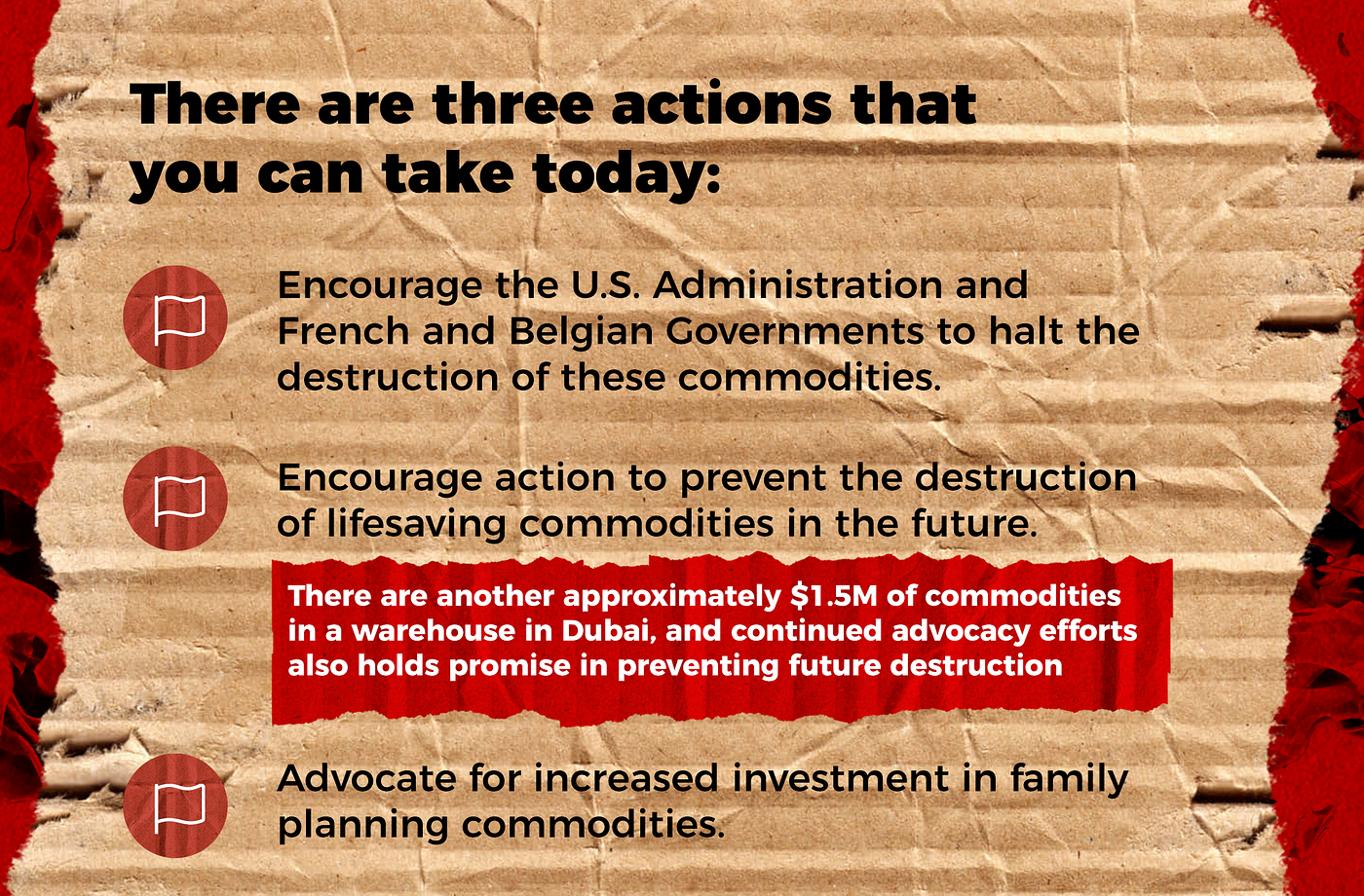
There are three actions that you can take today to ensure that women and girls continue to get the reproductive health supplies they need:
- Encourage the U.S. Administration and French and Belgian Governments to halt the destruction of these commodities. There are interested buyers and the U.S. Government should return to negotiations with interested parties, ensuring that the commodities get their intended destination and saving U.S. taxpayers money. The French and Belgian Governments are also positioned to prevent this destruction.
- Encourage action to prevent the destruction of lifesaving commodities in the future. There are another approximately $1.5M of commodities in a warehouse in Dubai, and continued advocacy efforts also holds promise in preventing future destruction.¹⁴ Policy action is already underway in both the U.S. House and Senate to prevent the unnecessary destruction of foreign assistance commodities.¹⁵ ¹⁶ Maintaining momentum and continuing to elevate collective advocacy messages to prioritize the preservation of lifesaving commodities will be critical.
- Advocate for increased investment in family planning commodities. Without the U.S. investment in family planning commodity procurement, the funding gap will continue to grow. Urgent, collective action is needed to ensure that family planning commodities are financed.
References
- Ranking Member Shaheen, Senator Murkowski Urge Secretary Rubio to Reverse State Department Decision to Destroy Family Planning Commodities Abroad. Senate Foreign Relations Committee. 1 July 2025. Accessed via https://www.foreign.senate.gov/press/dem/release/ranking-member-shaheen-senator-murkowski-urge-secretary-rubio-to-reverse-state-department-decision-to-destroy-family-planning-commodities-abroad.
- Kannampilly, A and Landay, J. ‘US-funded contraceptives for poor nations to be burned in France, sources say.’ Reuters. 24 July 2025. Accessed via https://www.reuters.com/legal/litigation/us-funded-contraceptives-poor-nations-be-burned-france-sources-say-2025-07-24/.
- Kannampilly, A and Landay, J. ‘US-funded contraceptives for poor nations to be burned in France, sources say.’ Reuters. 24 July 2025. Accessed via https://www.reuters.com/legal/litigation/us-funded-contraceptives-poor-nations-be-burned-france-sources-say-2025-07-24/.
- Kelly, M; Lee, JS; Swaine, J; and Blaskey, S. ‘The U.S. bought $12 million in aid for poor nations. Under Trump, it may be destroyed.’ The Washington Post. 5 June 2025. Accessed via https://www.washingtonpost.com/investigations/2025/06/05/usaid-money-hiv-contraceptives-trump-destroyed/.
- Our membership includes governments, advocates, nongovernmental organizations, product manufacturers, and donors. And, it spans the globe.
- Damavandi, S; Sully, EA; Friedrich-Karnik, A; Tignor, M. ‘Just the numbers: the impact of US international family planning assistance, 2024.’ Guttmacher. February 2025. Accessed via https://www.guttmacher.org/2025/02/just-numbers-impact-us-international-family-planning-assistance-2024.
- Setting a roadmap for quantifying the impact of U.S. government policy shifts on family planning.’ 12 March 2025. Updated June 2025. RHSC, Avenir Health, FP2030, Guttmacher, KFF, UNFPA. Accessed via https://www.rhsupplies.org/uploads/tx_rhscpublications/user_upload/Future-of-FP-Data-Presentation.pdf.
- Setting a roadmap for quantifying the impact of U.S. government policy shifts on family planning.’ 12 March 2025. Updated June 2025. RHSC, Avenir Health, FP2030, Guttmacher, KFF, UNFPA. Accessed via https://www.rhsupplies.org/uploads/tx_rhscpublications/user_upload/Future-of-FP-Data-Presentation.pdf
- Family Planning Market Impact Memo. CHAI, RHSC. June 2025. Accessed via https://fp-report.com/reports/FP-Market-Memo.pdf.
- Damavandi, S; Sully, EA; Friedrich-Karnik, A; Tignor, M. ‘Just the numbers: the impact of US international family planning assistance, 2024.’ Guttmacher. February 2025. Accessed via https://www.guttmacher.org/2025/02/just-numbers-impact-us-international-family-planning-assistance-2024.
- ‘Response to the U.S. State Department’s senseless plan to destroy supplies and deny contraceptive care. Joint statement by IPPF, Le Planning familial, Sensoa, Fédération Laïque de Centres de Planning Familial, Planned Parenthood Federation of America, and Countdown 2030 Europe.’ IPPF. 25 July 2025. Accessed via https://europe.ippf.org/media-center/response-us-state-departments-senseless-plan-destroy-supplies-and-deny-contraceptive.
- ‘Unconscionable: US plan to destroy $9.7 million of contraceptives.’ MSF. 24 July 2025. Accessed via https://www.doctorswithoutborders.org/latest/unconscionable-us-plan-destroy-97-million-contraceptives.
- [Javaid, M; Lee, JS; Kelly, M. ‘Trump administration to destroy birth control intended as aid.’ The Washington Post. 27 July 2025. Accessed via https://www.washingtonpost.com/world/2025/07/26/contraceptives-belgium-usaid-destroyed-trump/.
- Kelly, M; Lee, JS; Swaine, J; and Blaskey, S. ‘The U.S. bought $12 million in aid for poor nations. Under Trump, it may be destroyed.’ The Washington Post. 5 June 2025. Accessed via https://www.washingtonpost.com/investigations/2025/06/05/usaid-money-hiv-contraceptives-trump-destroyed/.
- ‘Ranking Members Shaheen and Schatz introduce legislation to prevent lifesaving U.S. aid from going to waste.’ Senate Foreign Relations Committee. 11 July 2025. Accessed via https://www.foreign.senate.gov/press/dem/release/ranking-members-shaheen-and-schatz-introduce-legislation-to-prevent-lifesaving-us-aid-from-going-to-waste.
- ‘Meeks, Frankel, Meng introduce legislation to prevent destruction of foreign aid commodities.’ House Foreign Affairs Committee. 18 July 2025. Accessed via https://democrats-foreignaffairs.house.gov/2025/7/eks-frankel-meng-introduce-legislation-to-prevent-destruction-of-foreign-aid-commodities.